

It’s funny how time works. Fast and slow, the first few weeks post-op were difficult, barely being able to walk, but in just 3 months, there’s a lot of progression week-to-week.
After surgery I wanted to return to my apartment, but my physical therapist said NO STAIRS for at least 5 days post-op. I went straight to mom’s from the hospital and stayed for 10 days, in a makeshift bedroom in her living room, with her driving me back and forth to PT visits (you’re not allowed to drive for 2 weeks post, until your knee can bend). Early PT consisted of managing swelling, stretching and mobility. They would start with ice, then heat, then manual therapy, working on range of motion and straightening of the knee and leg, hamstring and calf stretches, and electrical quad stimulation. The straightening of the leg is incredibly important, as the knee can stiffen, and some people end up not being able to fully extend their leg thereafter. This is also why when you elevate, the pillow should be under your ankle, not your knee, so it’s not bending.
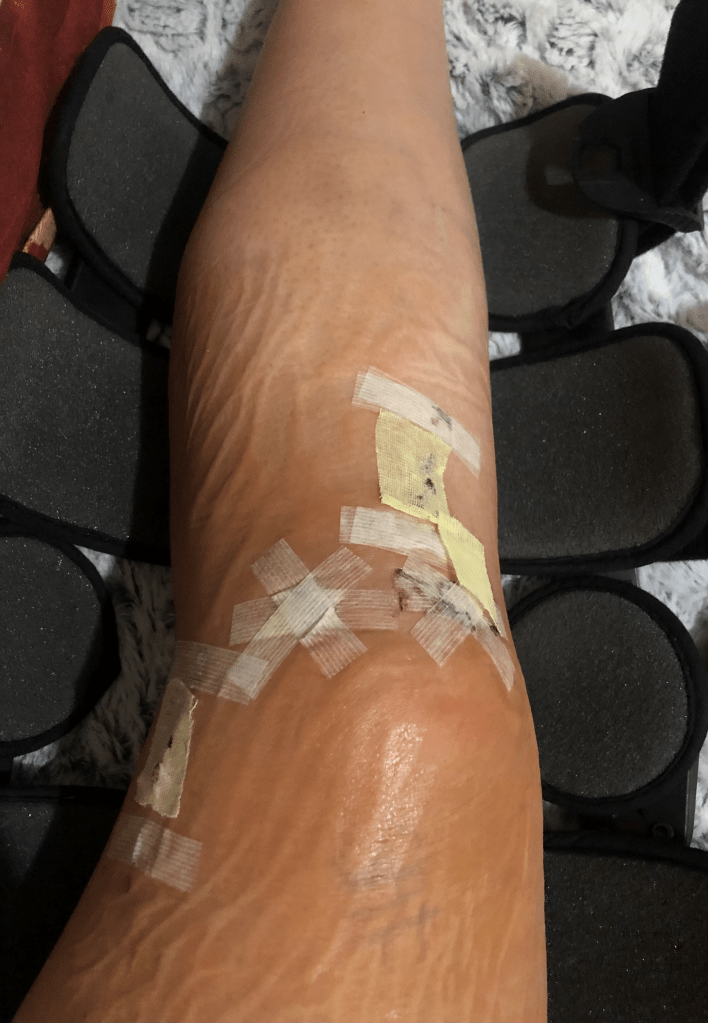
Speaking of elevating, the post-op instructions outlined to ice and elevate whenever possible. At first I even slept with my leg slightly elevated, locked in the brace, but my leg was so heavy with the swelling it made it very uncomfortable. I double-checked with the Dr.’s office, who gave the OK to sleep with the leg flat, and that helped, but sleep was still hard. Whether from the anesthesia, or a new environment, my sleep pattern was off for the first week or two. I would be exhausted by 9pm, but then wake up wide awake at 2am. I was very lucky that I wasn’t in a lot of pain the days following. I took one or two of the prescribed painkillers and that was it! I think if I had had a autograft, I would have needed the painkillers more, since you’re healing from two open wounds. Even still, I was scared to take the dressing off after 3 days, per instructions, to see what I would find. It turned out to be not that bad, even for someone as squeamish as myself. The PT clinic covered up the open wounds with clear bandages and a new Ace wrap until my first post-op Dr. visit.
STAIRS
By week 2 of PT, we had gone over proper technique for walking with crutches. It took my brain a minute to coordinate how to walk naturally again, and by necessity I was taught how to maneuver stairs properly. At this point I couldn’t even lift my left leg by itself, I needed to use my right foot as a hook for support, so getting the left leg up the stairs was a challenge. For going up, you start with the good leg and bring the bad one up, and for going down, you put the crutches down and then step down with the bad first. Going up is much easier as it’s glute (butt) work, while going down is quad. The leg was still too heavy to lift at my very first attempt at the stairs going home, so I ended up scooting up backwards, sitting down.
After you become somewhat more mobile, then comes walking without crutches (yeek!), which means working on core and balance. The first few steps without any support were like walking across a tightrope as I felt the need to reach out to hold onto something for stabilization. I learned walking is a full body activity!
DIET
My mom and PT emphasized eating enough protein after surgery. Protein is very important post-op as it helps to repair damaged body tissues. You can find more details here. I had a lot of soups with chicken or eggs and I was conscious to minimize carbs since I was mostly sitting the first month.
I also took vitamins and supplements, as there are certain minerals and nutrients that can also help with recovery, mostly Calcium, Magnesium, Zinc, and Vitamin C as outlined by Dr. Bill Sterett here!
SWELLING
I used the ice machine regularly in the first two months post, at least 3-4x a day. The leg was still looking pretty crazy 2 weeks after surgery. A Hispanic neighbor recommended making Arnica tea to help reduce the swelling. I didn’t know you could drink Arnica or that it helped with that, but figured I would give it a try. So off her suggestion I went to the local Hispanic market to buy loose leaf Arnica. Per WebMD, “The active chemicals in arnica may reduce swelling, decrease pain, and act as antibiotics. But arnica can be unsafe when taken by mouth unless it’s used in homeopathic dilutions.” I felt like it helped, and tasted pretty decent too, but always be careful and if you have any type of reaction discontinue. Once again, not a doctor, but just letting you know what worked for me. Link for more details here.
ENTERTAINMENT
I feel like this goes without saying, but I tried to be as stress-free as possible the immediate weeks after surgery and only consumed funny, upbeat, encouraging content. I kept going on my Scrubs marathon, Netflix stand-up specials, and relaxing music. Not only do you want to be rested physically but mentally as well!
DOCTOR FOLLOW UPS
The first two follow ups are typically 2 weeks apart, just to make sure there are no complications, especially with the incisions, and then it shifts to 6 week follow ups until you’re all cleared. At my 2nd follow up (1 month post), I was still in the brace, but only on one crutch. My PT had noticed I was breathing a little heavy at my visits, and I was getting light-headed when I had to transition from sitting to laying down. My blood pressure was also reading high. Out of an abundance of caution I went to Urgent Care to make sure I didn’t have a blood cot in my leg or my lungs, otherwise known as deep vein thrombosis and a pulmonary embolism. It’s rare but very serious if you do have it. At Urgent Care the doctor ran through a few manual tests–one of the symptoms of a blood clot is a swollen leg and my leg was still swollen from surgery! So just to continue to rule it out he ordered an EKG and an ultrasound for the leg. He said the ultrasound was better than a blood clotting test because it will actually show if there is a blockage. Net net I was cleared from a blood clot and the heavy breathing was most likely from not moving much the past month. The dizziness turned out to be benign vertigo, which a simple maneuver would help to resolve. Mostly what I learned is that when it rains it pours, and just be thorough in getting your symptoms checked out especially after a major operation.
CONCLUSION
- I would recommend taking at least 2 weeks off from work after surgery, even if you have a Work From Home job. I took 3 weeks off and it was helpful to be solely focused on recovery and healing. The anesthesia throws your sleeping off the 1st week and the next 2 weeks I was working on becoming more mobile and just managing the swelling, icing every few hours, and resting. If we were in pre-Covid times I would recommend taking at least 4 weeks off, until you’re able to walk comfortably
- Take note of any new symptoms you may have after the operation and bring them up to your doctor. I noticed the dizziness but hadn’t mentioned it until my physical therapist brought up the heavy breathing. She was the one that prompted me to mention all the new symptoms to the Dr.’s office, which led to all the tests. I don’t think I would have brought them up if she hadn’t pressed me, and even though my symptoms were benign it’s definitely better to be safe than sorry and I’m happy to have peace of mind
 Health | Fitness | Lifestyle